Why Inulin Isn't Digested, It's Fermented
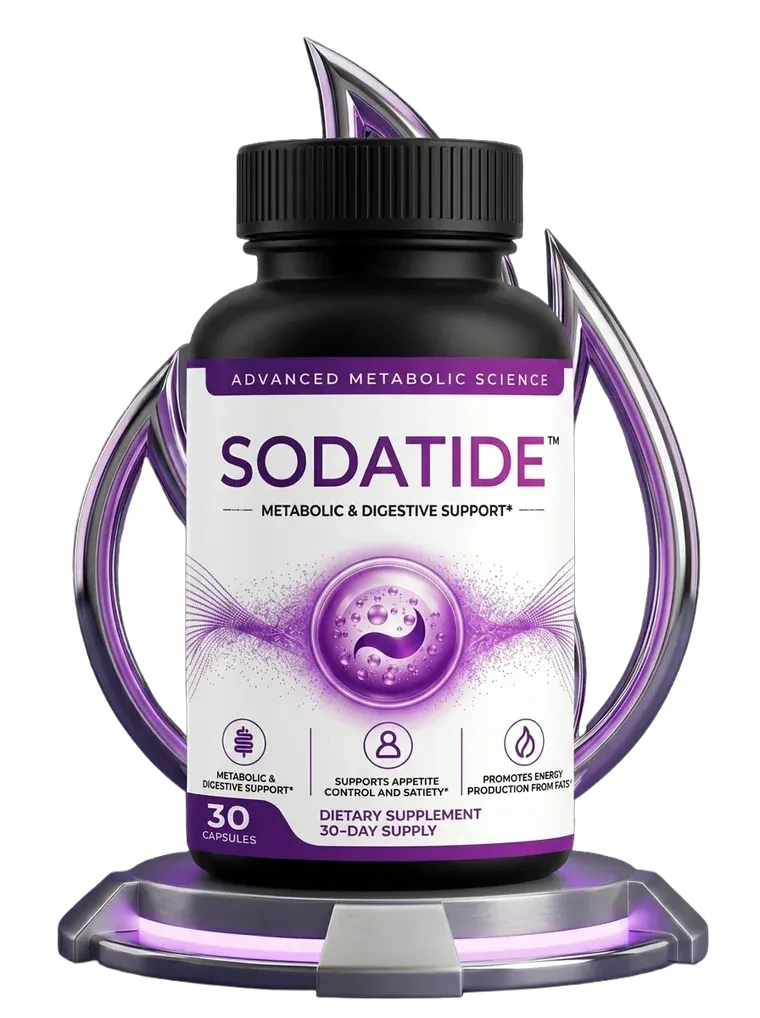
Chicory root inulin is a fructan: a chain of fructose units joined by a beta(2→1) bond. Human digestive enzymes are built to cut alpha-linked starches, not that bond, so inulin passes through the stomach and small intestine essentially unchanged. It is bacteria living in the colon, not your own digestive system, that break it apart. That process is fermentation, and it is a different biological event from digestion. Sodatide's label lists 211 mg of chicory root inulin (Cichorium intybus root) per capsule.
What is inulin, chemically? A fructan chain, not a sugar
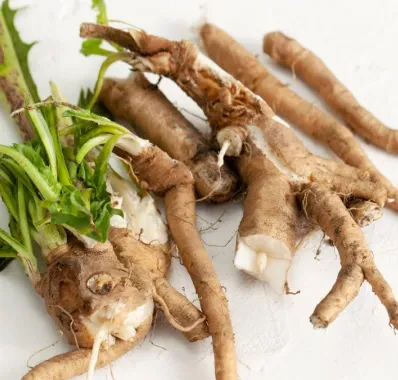
Inulin belongs to a class of carbohydrates called fructans: chains built almost entirely from fructose units, usually capped with a single glucose unit at one end. A chicory-root inulin molecule can run anywhere from about 2 to 60 fructose units long, which is why food scientists describe inulin as a mixture of chain lengths rather than one fixed molecule.
Chain length is also how the fructan family splits into related names seen on other labels. Shorter chains, roughly 2 to 9 units, are usually called fructo-oligosaccharides (FOS) or oligofructose. Longer chains, up to about 60 units, are what the word “inulin” most precisely refers to. A native chicory extract is naturally a mix of both lengths unless a manufacturer has specifically fractionated it.
That matters because the word “sugar” creates the wrong mental picture. Table sugar (sucrose) is two linked sugar units your body opens in seconds. Inulin is dozens of fructose units welded together end to end. Length alone would slow digestion down. The specific chemical bond holding those units together is what stops it almost entirely.
Where the name comes from
Inulin was first isolated from the plant genus Inula in the early 1800s, long before anyone understood fructans or fermentation. The name stuck. Chicory root (Cichorium intybus) is the commercial source used today because the root stores a high concentration of it as an energy reserve, the plant equivalent of how animals store glycogen.
The bond human digestive enzymes cannot cut
Digestion of carbohydrates depends on enzymes shaped to fit a specific chemical bond, the way a key fits one lock. Salivary and pancreatic amylase break the alpha(1→4) bonds in starch. Sucrase, at the small intestine's brush border, breaks the alpha(1→2) bond in table sugar. Lactase breaks the beta(1→4) bond in milk sugar, which is exactly why people without lactase cannot digest lactose.
Inulin's fructose units are joined by a beta(2→1) glycosidic bond. No enzyme in human saliva, stomach acid, or the pancreatic and brush-border enzyme set is shaped to open that particular bond. This is not a matter of degree or a “slow” digestion — the bond is simply not a substrate for any enzyme the human digestive tract produces.
Grazing animals such as cattle get around this with the help of a fermentation chamber (the rumen) packed with bacteria that do carry the right enzymes. Humans do not have a rumen, but the large intestine serves a related, later-stage purpose, which is covered below.
The trip through the small intestine: present, but untouched
Swallowed inulin dissolves in the stomach's watery contents (it is a soluble fiber) and moves into the small intestine along with everything else from a meal. This is the part that surprises people: inulin is not blocked from entering the small intestine, and it is not destroyed by stomach acid. It is physically present the whole way through.
What does not happen is absorption. The small intestine's lining absorbs digested nutrients, glucose, amino acids, fatty acids, through specific transport proteins embedded in the cell membrane. Those transporters are built to recognize small, specific molecules. An intact fructan chain of 2 to 60 units is too large and the wrong shape for any of them.
So inulin travels the full length of the small intestine as a passenger, not a participant. No breakdown, no absorption, no calories extracted at this stage. By the time the digestive contents reach the ileocecal valve, the gateway into the large intestine, the inulin that was swallowed is still, chemically, inulin.
Digestion vs. fermentation: two different processes
“Digestion” and “fermentation” both end with a molecule getting broken into smaller pieces, which is why the two get blurred in casual conversation. Biologically they are not the same event, and the table below is the clearest way to see why.
| Feature | Digestion | Fermentation |
|---|---|---|
| Where it happens | Mouth, stomach, small intestine | Colon (large intestine) |
| What does the breaking | Your own enzymes | Enzymes made by resident bacteria |
| Speed | Minutes to a few hours | Hours, continuing over roughly a day |
| End product absorbed | Glucose, amino acids, fatty acids | Short-chain fatty acids (acetate, propionate, butyrate), plus gas |
| Who benefits first | Your cells, directly | The bacteria, then your colon cells and, to a smaller extent, the rest of the body |
Inulin skips the left column of that table entirely and goes straight to the right one. That is the whole basis for calling it a prebiotic fiber rather than a digestible carbohydrate (Gibson and Roberfroid, 1995, the paper that introduced the prebiotic concept using inulin-type fructans as its working example).
What happens once inulin reaches the colon
The colon is not sterile plumbing. It holds a dense, resident community of bacteria, and a meaningful share of them carry enzymes called fructanases (or inulinases) that do what human cells cannot: cut the beta(2→1) bond. Bifidobacterium species are particularly well equipped for this and are consistently among the bacteria that expand when inulin-type fructans are present.
Once a bacterium's enzymes open the chain, the freed fructose units are pulled inside the bacterial cell and used as fuel for its own growth. This is bacterial metabolism, not a service performed for the host out of nowhere; your gut microbes eat the fiber because it is food for them. The benefit to the person eating the fiber comes secondhand, from what those bacteria produce and release as a byproduct of growing.
Arrival, intact
Inulin reaches the colon chemically unchanged, exactly as it entered the mouth.
Bacterial enzymes attach
Fructanase-carrying bacteria, Bifidobacteria prominent among them, bind and begin cutting the chain.
Fructose is consumed by the bacteria
Freed sugar units are taken up and fermented for bacterial energy and growth.
Byproducts are released
Gas and short-chain fatty acids are left behind, and those are what reach the host.
The byproducts: gas, short-chain fatty acids, and why response varies
Bacterial fermentation of inulin produces short-chain fatty acids, mainly acetate, propionate and butyrate, along with carbon dioxide, hydrogen and sometimes methane gas. The short-chain fatty acids are absorbed through the colon wall and used locally (butyrate is a preferred fuel for the cells lining the colon) or circulated in smaller amounts elsewhere in the body. The gas is the same gas responsible for the bloating people sometimes associate with inulin, especially at higher intakes.
Fermentation outcomes are not identical from person to person. A controlled trial that supplemented 174 healthy adults for two weeks with one of three fermentable fibers, including chicory-root inulin, found that resistant starch from potatoes produced the largest rise in short-chain fatty acids including butyrate, while inulin and maize-based resistant starch changed the gut community without producing a significant rise in fecal butyrate over that short window (Baxter et al., 2019). The authors point to differences in which specific bacterial species an individual's gut already hosts as the likely reason some people respond more than others.
The honest summary: inulin reliably gets fermented. What that fermentation yields, and how noticeably, depends on the fiber amount, the length of exposure, and the bacterial community already present in that person's colon.
Why “not digested” does not mean “zero calories”
Because inulin skips digestion and absorption, it is often described as contributing little to no calories, and that is broadly true compared with a fully digested carbohydrate like table sugar, which the body absorbs almost completely. But “not digested” is not the same statement as “not metabolized at all.”
The short-chain fatty acids produced during colonic fermentation are absorbed and do carry usable energy, just reached by a longer and less efficient route than direct digestion, and with some of that energy spent by the bacteria themselves along the way. Regulatory food-labeling conventions in different countries therefore do not treat fermentable fibers as true zero-calorie ingredients; they are generally counted as providing meaningfully fewer calories per gram than digestible starch or sugar, not none.
At the gram amounts used in whole foods or multi-gram fiber supplements, this distinction can matter for someone tracking intake closely. At the amount on this particular label, discussed next, it is not a meaningful practical factor either way.
What this means for the 211 mg on this label
This bottle's Supplement Facts panel lists Chicory Root Inulin, Cichorium intybus (root), at 211 mg per capsule, with a dagger instead of a percent Daily Value, because no FDA Daily Value exists for inulin on its own as a labeled percentage. You can see the full panel on the supplement facts page.
Everything covered above about the fermentation mechanism applies at any dose, from a trace amount up to the 12 grams or more a day used in the clinical research on inulin-type fructans. The mechanism does not change with dose. What changes with dose is how much fermentation activity, and how much of a short-chain fatty acid or gas response, a given amount is actually likely to generate. A milligram-range amount and a multi-gram clinical dose are feeding the same bacterial pathway at very different scales.
None of this changes whether inulin is a real prebiotic fiber; it is. It changes only what a given label amount of it is positioned to do.
Why Inulin Isn't Digested, It's Fermented: common questions
Is inulin digested in the stomach?
No. Stomach acid does not break the beta(2→1) bond that links inulin's fructose units. Inulin passes through the stomach chemically unchanged, the same as it does through the small intestine.
Why can bacteria break inulin down when human enzymes can't?
Many gut bacteria, Bifidobacterium species in particular, produce fructanase (inulinase) enzymes specifically shaped to cut the beta(2→1) bond. Human cells do not produce that enzyme at all.
Is fermentation the same thing as digestion?
No. Digestion uses enzymes your own cells make, happens in the mouth through small intestine, and absorbs the end products directly. Fermentation uses bacterial enzymes, happens in the colon, and the host only absorbs what the bacteria release as byproducts.
Does inulin have any calories if it isn't digested?
Some. The short-chain fatty acids produced when gut bacteria ferment inulin are absorbed and carry usable energy, just far less efficiently and at a lower amount per gram than a fully digested sugar or starch.
How much chicory root inulin is in this product?
This label lists 211 mg of Chicory Root Inulin, Cichorium intybus (root), per capsule, with a dagger shown instead of a percent Daily Value. See the supplement facts page for the full panel.
Does everyone ferment inulin the same way?
No. A controlled human trial found that response varied by individual, tied to which specific fermenting bacteria a person's colon already hosted, not just to the amount of inulin supplied.