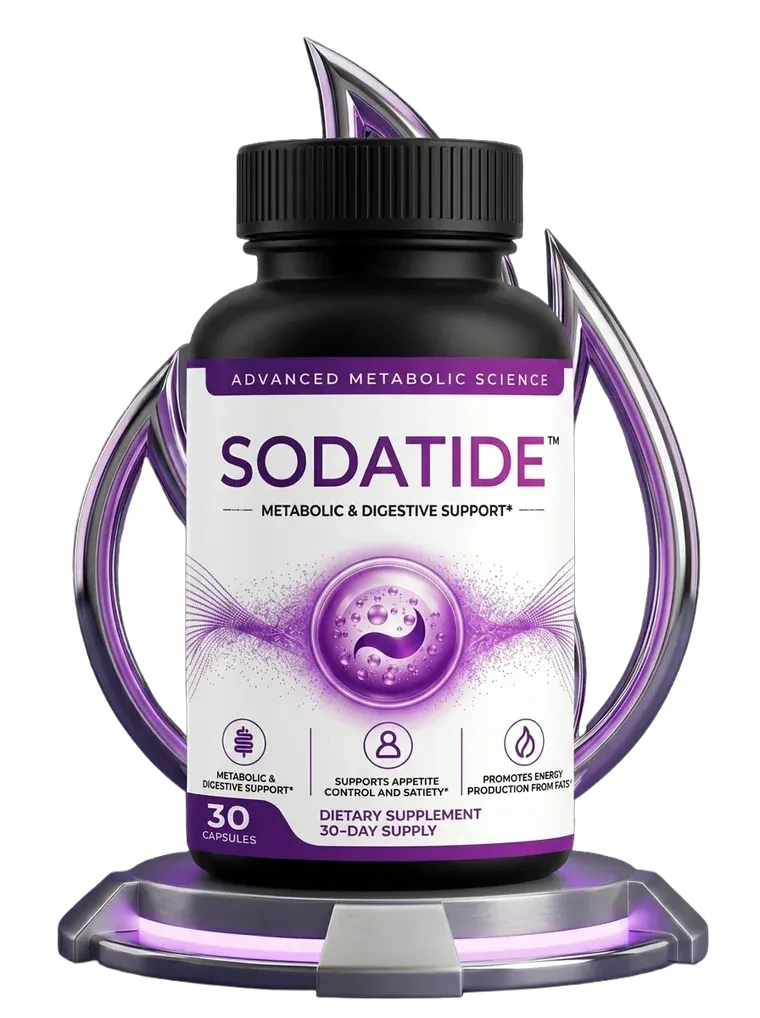
Sodatide Benefits: What the Research Shows
Sodatide claims three benefits, and digestion has the strongest research behind it.
The claims are metabolic and digestive support, appetite control and satiety, and energy production from fats. The studies used grams of fiber a day and none tested Sodatide itself.
What benefits does the Sodatide label claim?
The Sodatide label claims three benefits: metabolic and digestive support, appetite control and satiety, and energy production from fats. All three are structure/function claims, marked with an asterisk.
Supplements may use this kind of claim without FDA review, as long as the label carries the FDA statement (FDA, 2024). The claims describe support for normal body functions. They do not promise to treat anything.
Metabolic & Digestive Support
Fiber feeds gut bacteria, which supports regular digestion and a healthy metabolic response.
Supports Appetite Control And Satiety
Fermented fiber can raise the gut's own fullness signals after a meal.
Promotes Energy Production From Fats
Resistant starch has been linked to more fat used for energy after a meal.
Sodatide benefit 1: metabolic and digestive support
The first Sodatide claim rests on its fibers feeding gut bacteria. Inulin and resistant starch both reach the colon, where they are fermented into short-chain fatty acids.
What the research shows
- Chicory inulin at 12 g a day raised stools from 3.0 to 4.0 a week in people with constipation (Micka et al., 2017).
- Potato resistant starch at 3.5 g a day raised Bifidobacterium and Akkermansia (Bush et al., 2023).
- Resistant starch at 30 g a day improved insulin sensitivity over 4 weeks (Robertson et al., 2005).
- A pasteurized Akkermansia supplement improved insulin sensitivity over 3 months (Depommier et al., 2019).
Where the evidence stops
Not every trial agreed. In people at risk of type 2 diabetes, potato starch did not change insulin sensitivity, though fasting glucose was lower (Sanders et al., 2021). A mixed probiotic and inulin formula gave only a borderline result on after-meal glucose (Perraudeau et al., 2020). The inulin trial was funded by an inulin maker.
Sodatide benefit 2: appetite control and satiety
The second Sodatide claim links fiber to feeling full. When bacteria ferment fiber, the gut wall can release hormones that tell the brain you have eaten.
What the research shows
- Over 2 weeks, prebiotic fiber lowered hunger and raised GLP-1 and PYY (Cani et al., 2009).
- Over 12 weeks, people ate less, ghrelin fell and PYY rose (Parnell and Reimer, 2009).
- After a large dose of resistant starch, people ate less at later meals (Bodinham et al., 2010).
Where the evidence stops
The two fullness trials used oligofructose, a close cousin of inulin, not chicory inulin itself. They were small, with 10 and 48 people. In the resistant starch study, food intake dropped but hunger ratings did not change. So the feeling of fullness and the amount eaten do not always move together.
Sodatide benefit 3: energy production from fats
The third Sodatide claim is that it promotes energy production from fats. This rests mainly on resistant starch and how it shifts fuel use after a meal.
What the research shows
- In single test meals, fat burning rose 23% when 5.4% of the carbs were resistant starch (Higgins et al., 2004).
- Over 4 weeks, resistant starch improved how the body handled insulin (Robertson et al., 2005).
Where the evidence stops
This claim has the thinnest support of the three. The fat-burning study used corn starch, not potato starch, and only 12 people. The effect showed up at the lower dose but not at the higher one. In the 4-week study, body weight did not change.
What role do the Sodatide probiotics play in the benefits?
The three Sodatide probiotic strains back up the fibers rather than carry a claim of their own. Each one ties into the gut pathway in a different way.
- B. infantis belongs to the Bifidobacterium group, which feeds on inulin.
- C. butyricum makes butyrate, the same acid that fiber fermentation produces.
- A. muciniphila lives in the gut's mucus layer and is studied for metabolic health (Depommier et al., 2019).
Probiotic effects depend on the exact strain and the number of cells (NIH ODS, 2025). The Sodatide label gives species names and a 36 mg weight, but no CFU count. That makes the probiotic share of each benefit hard to pin down. Read more in what Akkermansia is.
Sodatide benefits at a glance: claim, ingredient, evidence and dose
The table links each Sodatide claim to the ingredient behind it and the dose the research used. Compare the last column with the amount in one capsule.
| Label claim | Main ingredient | Evidence | Dose used in research | Sodatide per capsule |
|---|---|---|---|---|
| Metabolic & Digestive Support | Chicory root inulin | More stools per week (Micka et al., 2017) | 12 g a day | 211 mg |
| Metabolic & Digestive Support | Potato resistant starch | More Bifidobacterium and Akkermansia (Bush et al., 2023) | 3.5 g a day | 100 mg |
| Metabolic & Digestive Support | A. muciniphila | Better insulin sensitivity (Depommier et al., 2019) | 10 billion cells a day | Part of 36 mg, CFU not published |
| Supports Appetite Control And Satiety | Inulin-type fiber | Less hunger, more GLP-1 and PYY (Cani et al., 2009) | 16 to 21 g a day | 211 mg |
| Supports Appetite Control And Satiety | Resistant starch | Less food eaten later (Bodinham et al., 2010) | 48 g in one day | 100 mg |
| Promotes Energy Production From Fats | Resistant starch | 23% more fat burned after a meal (Higgins et al., 2004) | 5.4% of meal carbs, corn starch | 100 mg |
The research doses are much higher than one capsule. The dose section of the ingredients page sets the numbers side by side.
Why Sodatide benefits can vary from person to person
Sodatide benefits depend on the bacteria already in your gut, so two people can respond in different ways. Research on the same fiber shows this clearly.
In a trial of 174 adults, potato starch raised butyrate on average, yet 37% of people showed no rise (Baxter et al., 2019). What you eat shapes which bacteria live in your gut. Daily habits matter too. Someone who eats little fiber and skips doses will likely notice less than someone steady on both.
What Sodatide does not do
Sodatide is a daily fiber and probiotic supplement with three modest label claims. Anything beyond those claims is not something the label or the research supports.
- It does not treat, cure or prevent diabetes, obesity or any gut disease
- It does not promise weight loss or a set number of pounds
- It does not work like a prescription GLP-1 shot
- It does not replace a balanced diet, sleep or exercise
- It does not boost energy with caffeine or other stimulants
- It does not give the gram-level fiber doses used in the studies
Everyday benefits of the Sodatide routine
Beyond the label claims, Sodatide has some simple practical benefits. They come from the format and the short formula, not from any study.
One capsule a day
No scoops, no mixing and no taste to cover.
A short, readable label
Three actives, each with a printed amount.
No stimulants
Nothing on the label to cause jitters or keep you up.
Vegetarian capsule
The hypromellose shell is plant-based.
Fiber and probiotics together
Two product types in one small capsule.
60-day window
Time to try it and decide, with a refund desk by phone.
How to get the most from Sodatide

You get the most from Sodatide by taking it every day and eating plenty of fiber-rich food. The capsule adds a small amount of fiber, and your meals can add much more.
- Take it at the same time each day
- Drink a full glass of water with it
- Add vegetables, beans, oats or fruit to your meals
- Keep the open bottle in the fridge
- Give it several weeks before you judge it
The daily routine is on the how to use page. The gut pathway explains why fiber matters, and the results timeline covers what to expect.
Sodatide benefits: common questions
What are the main benefits of Sodatide?
The label names three: metabolic and digestive support, appetite control and satiety, and energy production from fats. Each carries the FDA asterisk.
Does Sodatide help with weight loss?
Sodatide makes no weight-loss claim. In the fiber trials behind the ingredients, weight change was small or not significant.
Which Sodatide benefit has the strongest research?
Digestive support has the most human data. Chicory inulin raised weekly stool counts in a 4-week trial, though at 12 g a day.
Can Sodatide lower blood sugar?
Sodatide is not made to treat blood sugar or diabetes. Some ingredient studies saw better insulin sensitivity, but those tested far larger doses.
Why do the Sodatide claims have an asterisk?
The asterisk links to the FDA statement. It means the FDA has not evaluated the claims, which is the rule for all supplement claims of this type.
How soon might I notice a benefit?
The maker gives no timeline. The trials cited here ran from a single day to 3 months, and seller feedback points to 3 to 4 weeks.